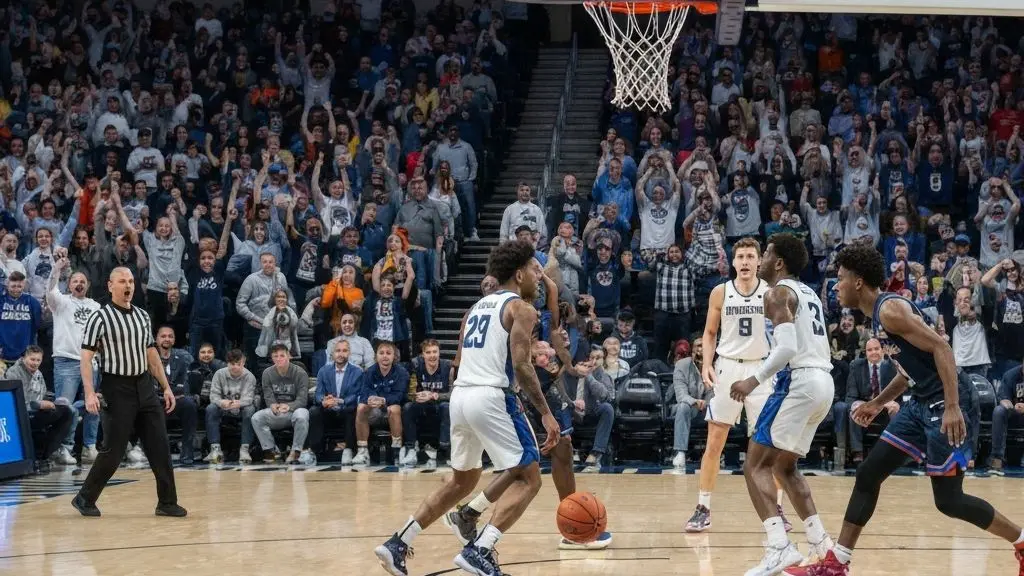
To analyze a CBB prop, project the player's role and usage first, adjust for matchup, pace and game script, then compare your number to the posted line and its price. Bet only when the gap is large enough to cover the break-even rate. The sections below walk through each step.
What Should You Check About the Player First?
Check role and usage first. Minutes, shot volume, assist opportunities, and rebound chances matter more than a single recent box score. Separate stable indicators from noisy outcomes. For example, a player can miss a points prop even when usage and attempts were strong.
Focus on recent form with context: last 5 and last 10 games are useful, but season-level baseline still matters. Use recent data to detect role changes, not to replace your entire projection.
How Much Does the Matchup Change a Prop?
The matchup changes a prop mostly through opponent style and pace. Defensive scheme, opponent pace, transition frequency, and rebounding profile can directly impact the same player line. A strong rebounding matchup may support over props, while a slow, physical game environment can reduce possession volume.
Also account for likely defensive assignments, foul risk, and potential blowout scripts. If a game has elevated blowout risk, star-player minute outcomes become wider and unders may gain value.
Why Does Conference Play Change Prop Numbers?
Conference play shifts stat lines because teams become familiar, pace can shift, and coaching adjustments are sharper. Non-conference numbers may overstate efficiency when a player moves into tougher conference matchups.
Fatigue and travel also matter. Short rest, altitude spots, and travel compression can impact shooting efficiency and minutes distribution, especially for depth-thin rotations.
How Does Game Script Affect Counting Stats?
Counting stats follow game script, so start from the projected total, spread, and pace to estimate opportunity. Higher-possession games generally create more counting-stat volume, while lower totals can suppress ceiling outcomes.
Correlation matters too. If your game model expects a low-total game, stacking multiple overs from the same matchup can unintentionally concentrate risk.
Is the Price as Important as the Pick?
Yes, because the same direction can be good at one number and bad at another. A prop over can be a good idea at one number and a bad idea at another. Compare available books and track closing movement. Small price differences add up over a season.
Treat your expected edge as a probability problem. If your projection only barely clears the posted line, you should demand better pricing or pass the bet.
What Hit Rate Do You Need to Break Even?
A prop needs to win more often than its break-even rate, and that rate depends on the format. At -110 the break-even is 52.4%, at -115 it is 53.5%, and at -120 it is 54.5%. On PrizePicks the multiplier sets it instead (see the official payouts page).
| Entry | Top multiplier | Break-even per pick |
|---|---|---|
| 2-pick Power Play | 3x | 57.7% |
| 3-pick Power Play | 6x | 55.0% |
| 4-pick Power Play | 10x | 56.2% |
| 5-pick Power Play | 20x | 54.9% |
| 6-pick Power Play | 37.5x | 54.7% |
| 3-pick Flex Play | 3x | 57.7% |
| 4-pick Flex Play | 6x | 55.0% |
| 5-pick Flex Play | 10x | 54.3% |
| 6-pick Flex Play | 25x | 54.2% |
Worked example: your projection says a player clears 15.5 points 58% of the time. At -110 that is above the 52.4% break-even, so the price is acceptable. As one leg of a 3-pick Power Play it is above the 55.0% break-even by only three points, so the entry needs two more picks of the same quality. A projection that only barely clears the line, with a 52% estimate, fails both tests.
How Should You Size and Track Prop Bets?
Good analysis still loses in the short run, so use flat staking or a conservative percentage model. Avoid increasing stake size simply because a pick feels strong after a winning streak.
Build a repeatable process: log your projections, lines, prices, and results. Review misses to identify whether your assumptions were wrong or variance just ran against you.
What Does a Repeatable CBB Prop Process Look Like?
- Project role and usage before checking the market line.
- Adjust for matchup, pace, and conference context.
- Include game script risk from spread and total.
- Shop for price and track line movement.
- Stake consistently and review results weekly.
The goal is not perfection on one slate. The goal is positive expected value over many decisions.
Use Free Tools Before You Bet
Explore player history and trend data to support your prop research.